988Pre-ChatSurvey:ReducingFrictionataNationalCrisisLine
Balancing crisis triage and user friction at national scale
Role
Lead Product DesignerDesign & Research (in partnership with UX Researcher)
Scope
- Generative Research (partnered)
- Usability Testing (partnered)
- Information Architecture
- Interaction Design & Prototyping
- Stakeholder Presentation
Stakeholders
- Vibrant Emotional Health
- Substance Abuse and Mental Health Services Administration (SAMHSA)
Status
Live at chat.988lifeline.org ↗Disclaimer
The views, opinions, and analysis expressed in this case study are the author's own and do not necessarily reflect the official views, opinions, or policies of the Substance Abuse and Mental Health Services Administration (SAMHSA), or the U.S. Department of Health and Human Services.
TL;DR
- —
Problem: The pre-chat survey was the very first thing a person in crisis encountered after clicking the “Chat” button — and it was functioning like a clinical intake form, creating a “speed bump” before anyone could reach a counselor.
- —
Approach: A phased product strategy to balance two competing needs: minimizing friction for vulnerable help-seekers while preserving the triage data crisis counselors needed to route care. Three releases addressed distinct layers — a technical accessibility fix, an IA restructure with progressive disclosure, and a compliance adaptation.
- —
Outcome: The redesigned entry point absorbed a 74% surge in national crisis volume while holding bounce rate stable — and when a federal mandate required removing the LGBTQI+ youth routing checkbox in September 2025, the modular IA meant zero structural redesign was needed.
The Problem: A Speed Bump in a Crisis
The 988 Lifeline operates at massive scale, handling millions of contacts annually across calls, texts, and web chat. For the roughly 60,000 people who reach out via browser-based chat each month, the pre-chat survey is the very first thing they see after clicking the “Chat” button.
Scale of the Problem
Since the 988 Lifeline launched in July 2022 through May 2024, the system handled 1.4 million web chats as part of roughly 10.8 million total contacts. At approximately 60,000 monthly chat users, even a modest improvement to the entry experience translates to thousands more people successfully connecting with a counselor each month.
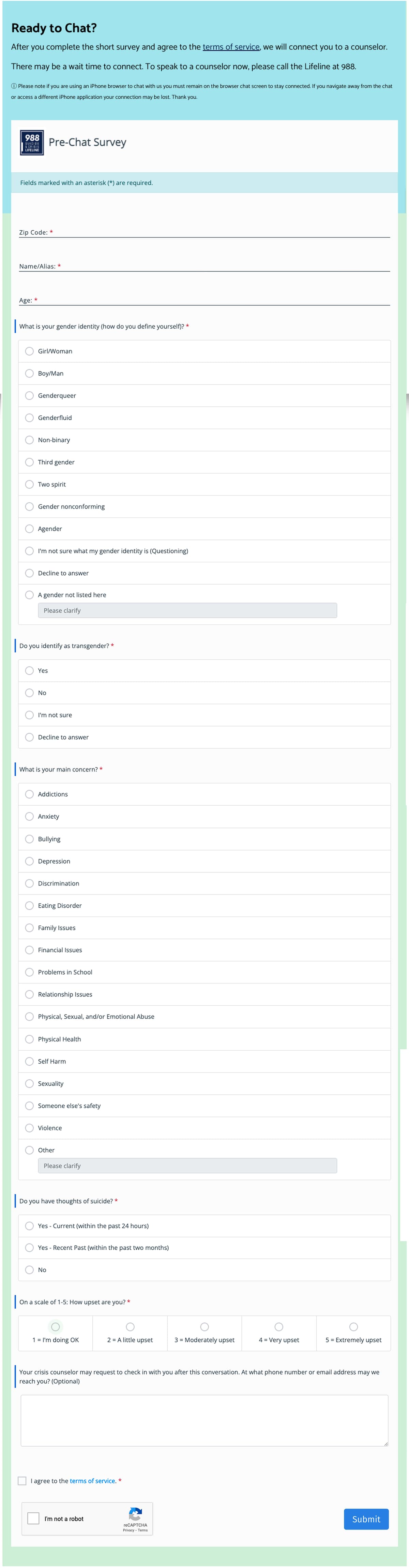
Before the redesign, that first moment was an overwhelming wall of text, radio buttons, checkboxes, and a reCaptcha puzzle, all loaded inside an iframe nested within a frame within another frame. Users expecting immediate connection with a counselor were instead greeted with what felt like a clinical intake form. Our generative research quantified the friction:
55%
Found the survey an unexpected barrier — expected to chat immediately
55%
Found the volume of text visually and mentally overwhelming
6 of 9
Participants experienced reCaptcha failure — it expired on most within 60 seconds of verification
Source: Chat Entry UX: Usability Findings with General Public (n=9)
“ReCaptcha is always a problem for me. ReCaptcha is a persistent problem with the blind community. The audio descriptions are not always good.”
Peter, screen reader user · Chat Entry UX: Usability Findings with General Public
Before — August 2024
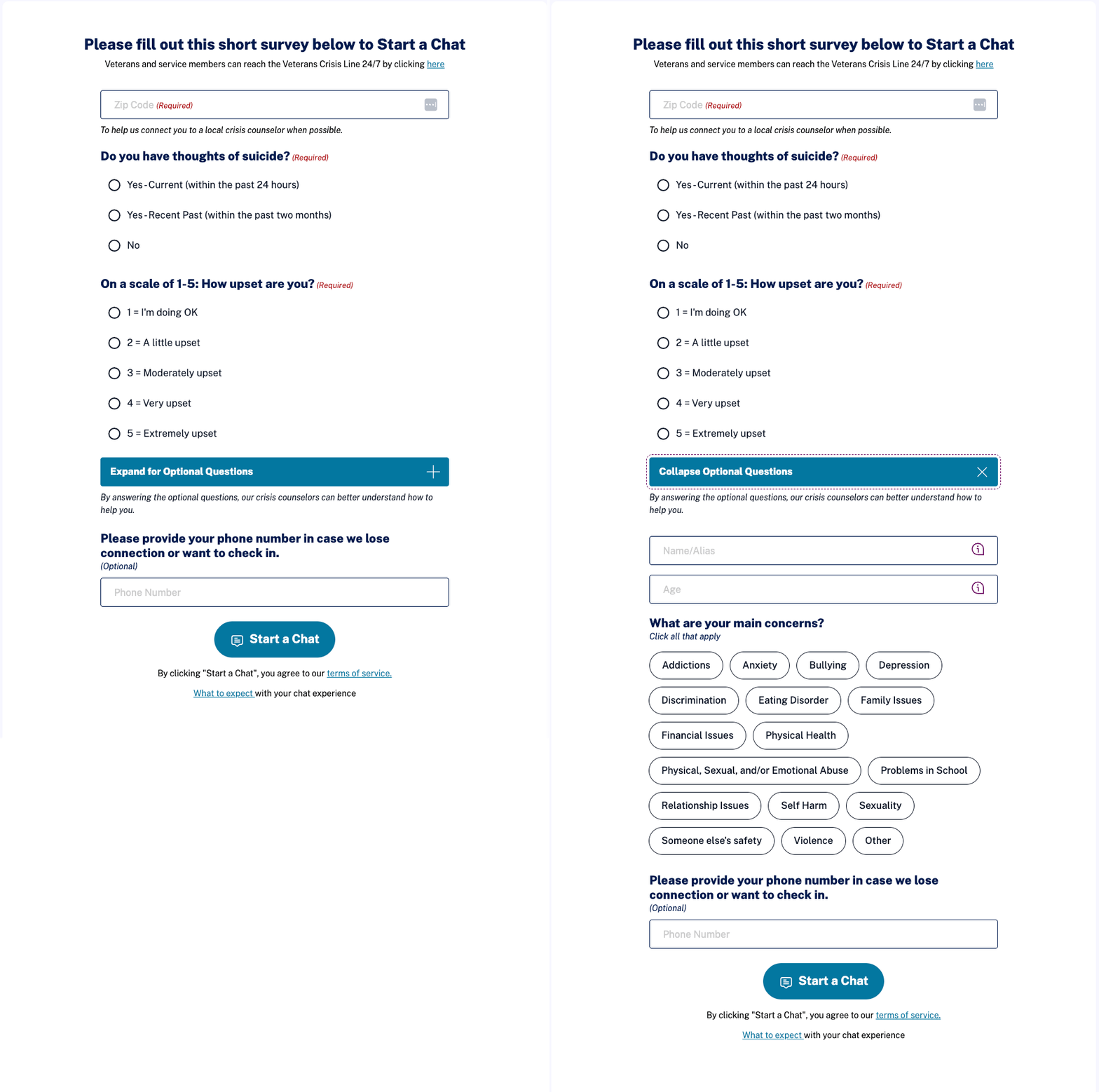
Current
Research: The Dual-Persona Trade-Off
Deleting the survey entirely wasn't viable. Crisis counselors depended on the data it collected to assess imminent risk, identify minors, and route local emergency resources. Eliminating the form would compromise their ability to provide effective care.
Working closely with my UX Research partner, we conducted internal interviews with crisis counselors to score each survey field by how helpful it actually was to their triage process. The goal was to separate what counselors needed at the point of entry from what could be gathered naturally during the chat itself.
Crisis Counselor Helpfulness Scores — Survey Fields
Rated out of 5 by crisis counselors in internal interviews
High counselor value — confirmed naturally in-chat
High counselor value — confirmed naturally in-chat
Routes to local crisis resources
Determines imminent risk level before chat begins
SAMHSA federal reporting mandate
Behind expand button — gathered in-chat if needed
Removed Sept 2025 per government Executive Order
* The LGBTQI+ youth routing checkbox was removed in Phase 3 following a federal compliance mandate — covered in Strategic Execution below.
The data revealed a clear counselor preference: Age and Name/Alias scored highest. But the design decision didn't map directly to helpfulness scores. SAMHSA federal reporting requirements mandated that Zip Code, Suicide Assessment, and the emotional state scale appear as required fields. Age and Name, despite their high counselor value, were moved behind the expand button because counselors confirmed they could gather them naturally within the first exchange of a chat. The goal was to minimize the visible form footprint without losing any triage capability.
Strategic Execution: Three Phased Releases
I led the design and prototyping across all three phases — translating research findings into a product strategy, driving the case for a technical reCaptcha upgrade, restructuring the IA around progressive disclosure, and adapting the form architecture when a federal mandate required a compliance update mid-product lifecycle.
Balancing Four Competing Needs
Vibrant Emotional Health
Maintain data quality and counselor routing capabilities across the national network
SAMHSA
Enforce federal reporting mandates: Zip Code, Suicide Assessment, and emotional state scale required by law
Crisis Counselors
Receive triage data before a chat begins: imminent risk, location, emotional baseline
Help-Seekers
Reach support immediately with minimal friction, especially under acute emotional distress
The Design Solution
Progressive disclosure: required fields visible by default, optional fields one tap away, modular IA adaptable to policy changes
Phase 1
March 2024Removing Technical Friction
Usability testing (“Chat Entry UX: Usability Findings with General Public,” n=9) found that 6 of 9 participants experienced reCaptcha failure — the puzzle expired on most within 60 seconds of verification. For users relying on screen readers, the audio-based fallback was unreliable. The research findings were used to advocate for an engineering update from Google reCaptcha V2 to V3: a seamless background verification that requires no user interaction and removes the barrier entirely.
Phase 2
August 2024IA Restructure & Progressive Disclosure
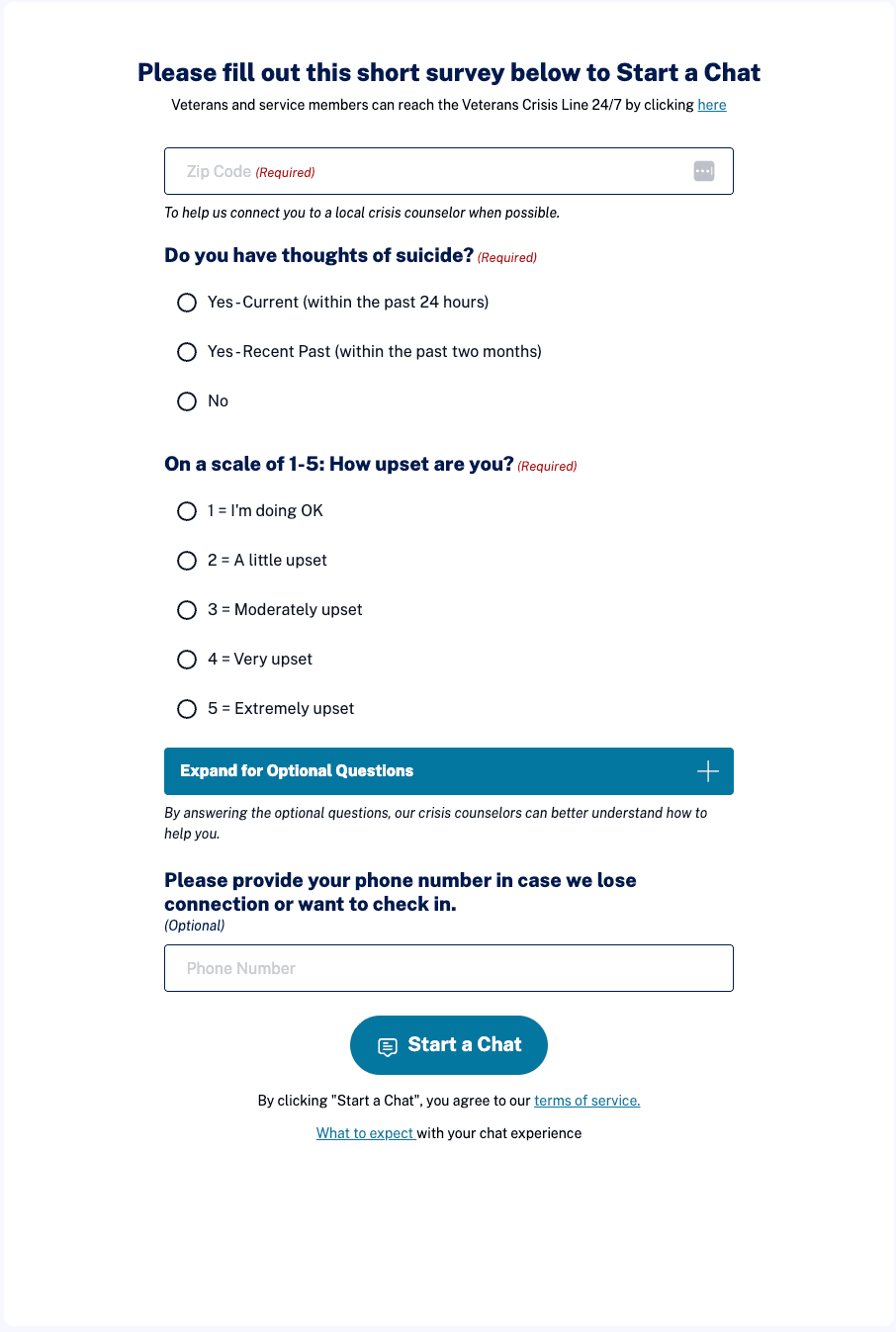
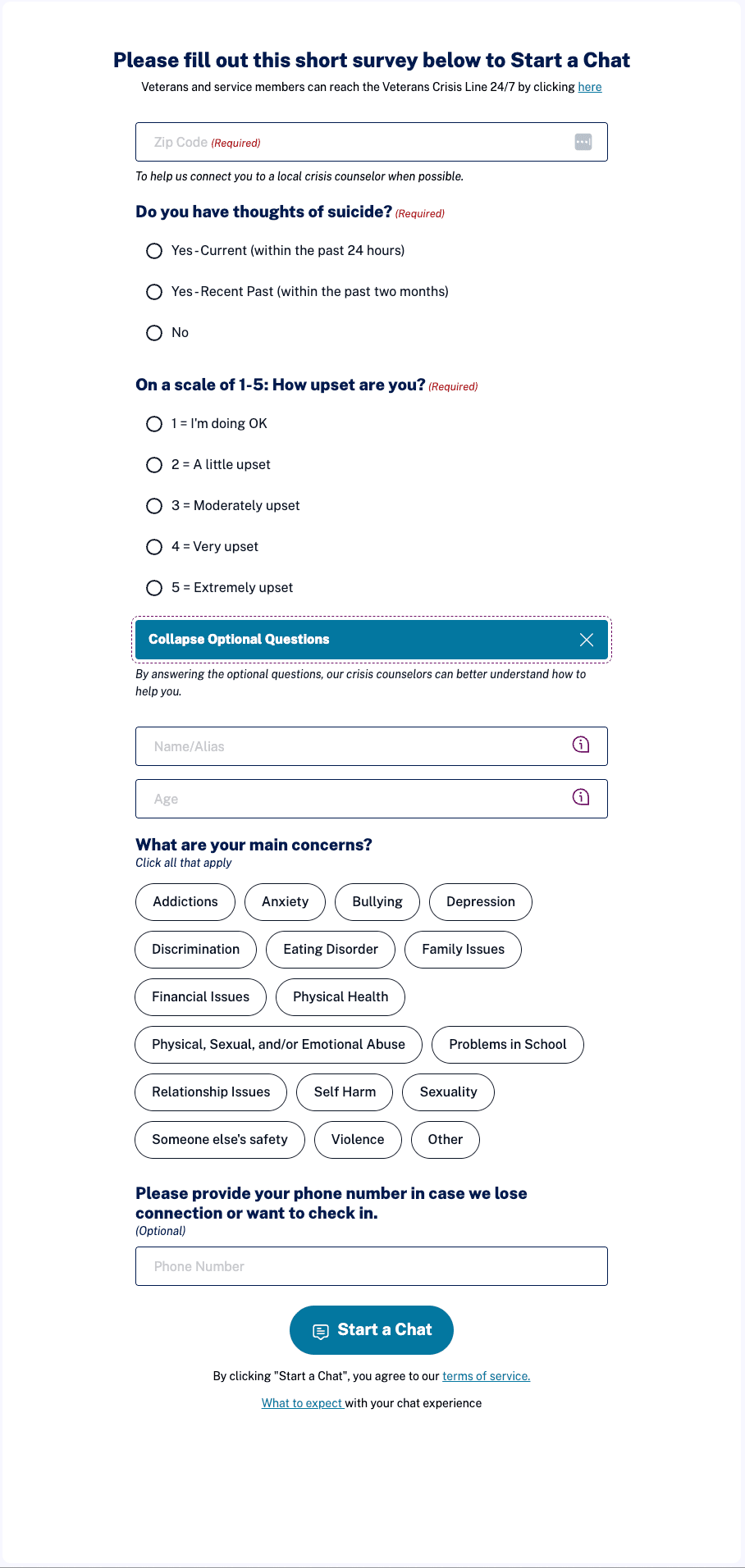
Reprioritized the form’s IA: surfaced the three required triage fields (Zip Code, Suicide Assessment, and emotional state) by default, while moving Age, Name, and other demographic questions behind a single “Expand for Optional Questions” button. This directly solved visual intimidation while preserving counselor data access. Critical triage dependencies are met first; the rest is available but not required.
Design Decision — Main Concerns Field
Multi-select radio dials → multi-select pills
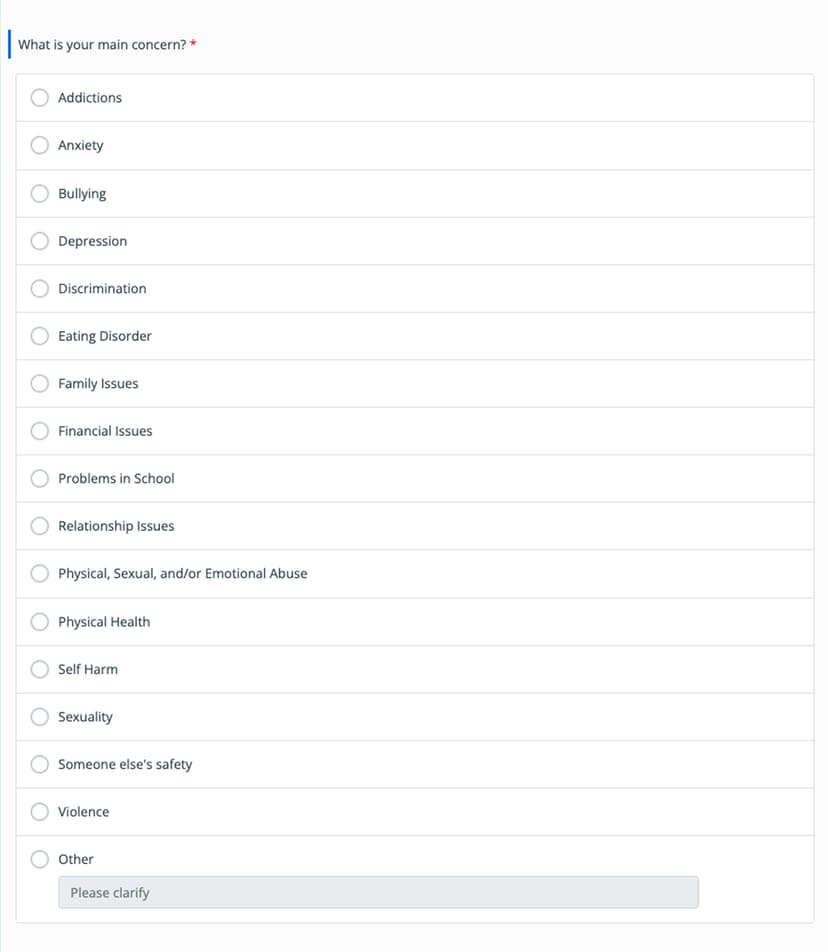
The original field — labeled “What is your main concerns?” — was a single horizontal row of single-select radio dials, a layout that forced horizontal scrolling on mobile and made scanning the full option set difficult on any screen size. I made two changes: corrected the label to “What are your main concerns?” and redesigned the field as multi-select pills arranged in a wrapping grid. Switching from single-select to multi-select better reflects the reality that someone in crisis is rarely dealing with just one concern. The new layout also reduced vertical space, improved touch target size on mobile, and made it faster to scan and select.
The “Other” option applies the same progressive disclosure principle: the pill appears inline with the rest of the options, but selecting it expands a text input directly below it. The field only takes up space when it is needed, keeping the form compact for the majority of users who won't use it.
Before — Radio Dials
After — Pills
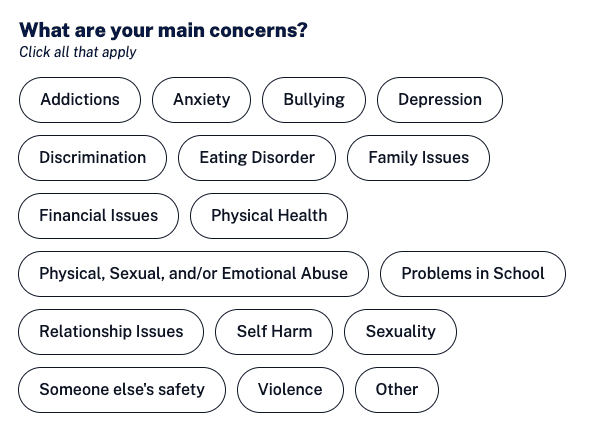
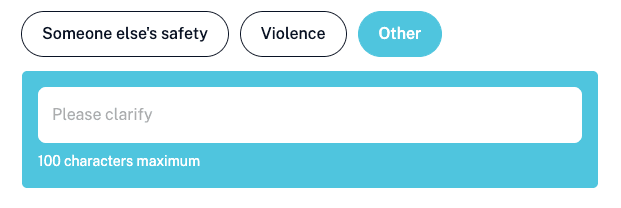
“Other” selected — reveals a text field for clarification
Optional Questions — Collapsed
Optional Questions — Expanded
Phase 3
September 2025Agile Compliance
On July 17, 2025, SAMHSA officially terminated the 988 Lifeline's LGBTQ+ Youth Specialized Services, eliminating the “Press 3” and “Text PRIDE” options that had connected LGBTQ+ young people to affirming counselors since 2022. In September 2025, I redesigned the pre-chat survey to remove the LGBTQI+ youth routing checkbox — “For LGBTQI+ youth/young adults, check here to connect to an LGBTQI+ trained crisis counselor” — which had supported routing to that now-discontinued service. The modular IA built in Phase 2 made the design update technically straightforward. The decision itself was not.
The Stakes of This Change
1.5M
LGBTQ+ young people served by the specialized service since 2022
19%
Of all 988 texts were routed through the LGBTQ+ specialized service
26%
Would not have contacted any other helpline if this service hadn’t existed (a uniquely unreachable population)
2.6×
Higher past-year suicide attempt rate among LGBTQ+ crisis service users vs. those using other counseling (26% vs. 10%)
Source: The Trevor Project, 988 Lifeline and Crisis Services Use Among LGBTQ+ Young People (2025). The service disproportionately reached ages 13–17, LGBTQ+ young people of color, those in rural areas, and those with fewer economic resources.
Impact: Scaling for a National Mental Health Crisis
The progressive disclosure model and restructured IA created a foundation resilient enough to absorb a dramatic surge in national crisis traffic without a corresponding increase in drop-offs. The metrics below compare an equivalent three-month window in early 2025 against early 2026 (Jan 1–Mar 31, 2025 vs. Feb 1–Apr 30, 2026), drawn from Google Analytics on the pre-chat survey page:
74.43%
Increase in total users — scaling from ~206K to ~360K
123.14%
Increase in page views — from ~405K to over 904K
~Stable
Bounce rate held at 44–45% — consistent with pre-redesign levels — despite the 74% volume surge
1m 31s
Average wait time to reach a counselor by May 2024 — showing the system absorbed the volume without degrading connection speed
What Stable Bounce Rate Means Here
A bounce rate that holds steady at 44–45% — consistent with pre-redesign levels — while user volume nearly doubles is a meaningful result. It means the redesigned entry point did not add drop-offs as the system was stress-tested by historically high crisis volumes. The UI scaled without degrading the experience for the most vulnerable users.
Next Steps & Reflection
The counselor research surfaced something the phased releases couldn't address — a gap in the feedback loop between the entry experience and what happens in the chat itself.
Post-Chat Feedback Loop for Counselors
Counselor interviews surfaced a highly requested feature: access to post-chat survey data so counselors could understand whether their interventions successfully helped the visitor. Designing this feedback loop would close the quality improvement cycle between the entry experience and the counseling outcome.
Reflection
This project reinforced that the hardest design problems in healthcare aren't about interface patterns. They're about navigating competing needs between people who have radically different relationships with the same product. A crisis counselor and someone in emotional distress interact with the same form for entirely different reasons. The research partnership was essential: without the counselor helpfulness scores, the progressive disclosure solution would have been a guess rather than a grounded decision.
Phase 3 also demonstrated the value of building for change. The modular IA established in Phase 2 meant that a compliance-driven field removal required no structural redesign. In a federally regulated product that operates at national scale, designing with adaptability in mind isn't a nice-to-have. It's a core requirement.
What Phase 3 also made clear is that technical ease and human impact aren't the same thing. Removing the LGBTQI+ routing checkbox was a ten-minute design update. The 1.5 million LGBTQ+ young people who had used the specialized service since 2022 — 26% of whom said they would not have contacted any other helpline — are the weight behind that update.